This Exercise was privately practiced by the 54 members of
Meeting the Muse Chapter of
Missouri State Poetry Society in 2004 as
written by founder Wanda Sue Parrott and
copyrighted by Amy Kitchener’s Angels Without Wings Foundation,
a non-profit literary corporation established July 31, 2001
in the state of Missouri.
It is shared here for the first time on this website so all people may experience dream catching.
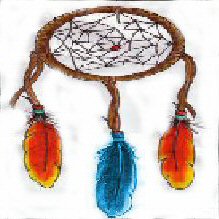
Native Americans on the plains created designs like the one above by intricately weaving and knotting threads, dried grass and leather strips from which three feathers were suspended. In the center was an opening that served an important double purpose. These devices were known as “Dream Catchers” because, outwardly, such an object hanging in a lodge or tepee was supposedly capable of catching negative vibrations (known as “bad dreams”) in the air by trapping them in the circular web (like a spider web); however, positive vibrations or “good dreams” passed through the “eye” of the web—the central space—to the sleeping person.
On a deeper-yet-practical level, the mandala enabled Indian medicine men, elders, and even music makers and poets to strengthen their mental prowess by focusing their concentration rather than scattering mental energies randomly. Their meditation technique may help you overcome writer’s block in your own quest to Meet the Muse (and become centered if you have been distracted by too much e-bombardment), so you may thus be inspirationally guided on your creative path during your spiritual journey.
Left: On the front of the card (at top), the feather on the thong at the left is symbolic of your waking state of mind.
Right: The feather dangling at the right is representative of your deep sleep and also the Great Spirit (or God), which is both infinite and invisible, and unknowable except through its manifestations.
Middle: The feather hanging down from the middle symbolizes mind, sacred domain of consciousness through which one is capable of perceiving both the infinite and finite manifestations of Great Spirit (or God).
Center (or Eye): The center, or eye, of the dreamcatcher’s web is the color Turquoise, which represents a tunnel, or pathway, leading to pure consciousness.
|
FRONT: Enter through turquoise feather |
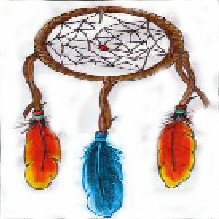 BACK: Exit through turquoise feather |
The three feathers suspended represent the Threefold Path
to and from the spiritual state of mind symbolized by turquoise.
The central feather in the web symbolizes the Path.
The turquoise feather (center) connecting the Entry (Front) and Exit (Back) symbolizes the realm in which your Muse functions and to which you journey as you enter sleep or return from it. It is also known as the domain of visions and dreams. Here, your mortal mind meets the immortal,and vice versa. The turquoise feather is a symbol on which to focus as you perform the following simple exercise to release pent-up creativity and invoke the Muse as your guardian, guide and guru.
Relax in silence and focus your gaze on the turquoise eye In the center of the web on the left side above.
Imagine you are traveling through a tunnel and emerge on the other side.
Before you dangles a beautiful turquoise feather.
As you approach the Turquoise Feather, it transforms into a Being that speaks to you in words only you hear.
Listen—and even go to sleep if you feel so inclined.
Listen—as you wake, if and when you feel inspired.
The image on the right side represents your return from sleep or deep meditation.
The feather at the left represents your spiritual sleeping state, and the right, the awake physical realm.
You reversed the direction and path you traveled as you emerge back to normal consciousness.
Each feather is a path and all paths lead to and from the Universal One.
May the dreams you catch all be good ones, and
May the Muse be with you.