The Diploemat--4
March-April 2012
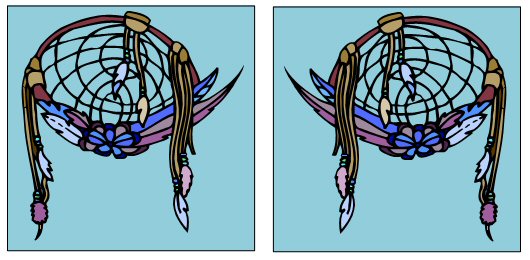
Native Americans on the plains created designs like the one above by intricately weaving and knotting threads, dried grass and leather strips from which three (sometimes more) feathers were suspended. In the center was an opening that served an important double purpose. These devices were known as “Dream Catchers” because, outwardly, such an object hanging in a lodge or tepee was supposedly capable of catching negative vibrations (known as “bad dreams”) in the air by trapping them in the circular web (like a spider web); however, positive vibrations or “good dreams” passed through the “eye” of the web—the central space—to the sleeping person.
On a deeper-yet-practical level, the mandala enabled Indian medicine men, elders, and even music makers and poets to strengthen their mental prowess by focusing their concentration rather than scattering mental energies randomly.
Their meditation technique may help you overcome writer’s block in your own quest to Meet the Muse (and become centered if you have been distracted by too much e-bombardment or other confusion), so you may thus be inspirationally guided on your creative path during your spiritual journey.
Your “tent” is actually a piece of cardstock or other stiff paper that can be folded in the center so it stands upright. For example, such a “tent” is a place card made from a 3 x 5 inch index card to indicate the chair reserved for a specific dinner guest at a sit-down dinner party or meeting. Larger name tents made from folded 8-1/2 x 11 inch card stock display names of speakers on a platform where a forum discussion is going on. One of the biggest forms of such a tent is the “sandwich board” worn front and back by walking human signboards who advertise everything from product sales, restaurant menus and theatrical productions to their own books, the front cover displaying the title on one’s breast and other blurbs on the back.
Your tent may be of any type and color of paper you choose, and its size is yours to decide. You may even make several Dream Catcher Tents so you have one handy in all rooms of your house, your purse or your wallet. The size is not important. The purpose of the tent is what matters. It is symbolic of the special space you enter in your own mind to attain silence, stillness of brain activity, and inspiration, your specific goal being to attune with the Great Spirit—otherwise known as the Muse. It is a tool to help you enter your Sacred Space. When you are not concentrating on your Dream Catcher Tent, it can be easily folded and tucked away.
The term “sweat lodge” is symbolic term for Holy of Holies, the highest level of consciousness in which your mind is freed of three-dimensional realities only. You may have visions, receive inspiration, find answers to problems, or just sense relief from burdens and pain.
In Native American sweat lodges, inspiration often comes as visions of the ancestors, totem animals, and the sacred White Buffalo. In your own spiritual sweat lodge, inspiration will manifest in terms of your own culture and understanding.
To make your own tent, fold your paper in the middle, then write in pencil at the bottom of one side “Front” and “Back” on the other. Unfold it and make sure the tent stands upright.
Then, paste or tape the images of the dream catchers shown below, one on the front and the other on the back. You may make copies of the pictures in this booklet or choose images of any dreamcatcher of your choice.
Familiarize yourself with the symbolism of the dream catcher’s features before proceeding with your meditation, in order to gain the most benefit.
Left: On the front of the image above, the feather at the left is symbolic of your waking state of mind.
Right: The feather dangling at the right is representative of your deep sleep and also the Great Spirit (or God), which is both infinite and invisible, and unknowable except through its manifestations.
Middle: The feather hanging down from the middle symbolizes mind, sacred domain of consciousness through which one is capable of perceiving both the infinite and finite manifestations of Great Spirit (or God).
Center (or Eye): The center, or eye, of the dreamcatcher’s web represents a tunnel, or pathway, leading to pure consciousness.
FRONT: Enter through turquoise feather BACK: Exit through turquoise feather
The turquoise feather (center) connecting the Entry (Front) and Exit (Back) symbolizes the realm in which your Muse functions and to which you journey as you enter sleep or return from it. It is also known as the domain of visions and dreams. Here, your mortal mind meets the immortal,and vice versa. The turquoise feather is a symbol on which to focus as you perform the following simple exercise to release pent-up creativity and invoke the Muse as your guardian, guide and guru.